The Data Doesn’t Exist Because We Didn’t Fund It. Let’s Change That.

I am tired of hearing that “the data does not exist.”
If you have ever sat in a doctor’s office describing joint pain, brain fog, sudden metabolic shifts, or the feeling that your body is changing overnight, only to be met with a shrug and a prescription for an antidepressant, you know exactly what I mean.
You ask why this is happening. You ask what the long-term effects are. You ask if body identical hormones can save you from the ravages of Alzheimers, heart disease and musculoskeletal decline. You ask how to protect your muscle, your bone, your brain, and your future.
And the answer, far too often, is: We just don’t have the data.
They are right. The data does not exist. But we need to be very clear about why it doesn’t exist.
It is not because women’s bodies are too complex to study. It is not because the science is impossible. The data does not exist because the research was never funded at the scale women deserved.
Let’s look at the numbers.
They are not just disappointing; they are a crisis.
A recent analysis by the National Academies of Sciences, Engineering, and Medicine (NASEM) found that from 2013 to 2023, just 8.8 percent of NIH grant spending focused on women’s health [1]. When you look globally, the picture is even bleaker: less than 1 percent of global health research and development funding goes toward women’s health conditions beyond cancer [2].
And when we look specifically at the diseases that disproportionately rob women of their independence—like Alzheimer’s, where women make up two-thirds of all cases—only 12 percent of the research funding goes to projects focused on women [3].
Within my own field, Orthopaedics, we have known for 100 years that women have rapid collapse of their cartilage and develop arthritis when they lose their estrogen and for 86 years that there is a treatable connection between bone health and estrogen decline….and yet 1:2 will still experience osteoporosis related fracture and total joint replacements for arthritis in women are expected to increase 450% over the next decades.
The result? Women spend 25 percent more of their lives in poor health or with disabilities than men do [4].
We have extended lifespan without adequately protecting the biological systems that allow women to move through life with strength, capability, and independence. We wait for the fracture. We wait for the joint failure. We wait for the decline to become undeniable before we intervene. And then we call it care.
I have spent my career inside this system as an orthopaedic surgeon and researcher. I have cared for women whose bodies told the story of a medical establishment that waited too long to prioritize prevention, performance, and research.
But I have never believed that aging is an inevitable decline from strength to frailty. Longevity is built. By design. And building requires investment—not just in ourselves, but in the science that makes our choices possible.
We can no longer wait around hoping societal and political winds will change to do the right thing by 51 percent of the population. We must take action.
Womens Health Research has always been an uphill climb.
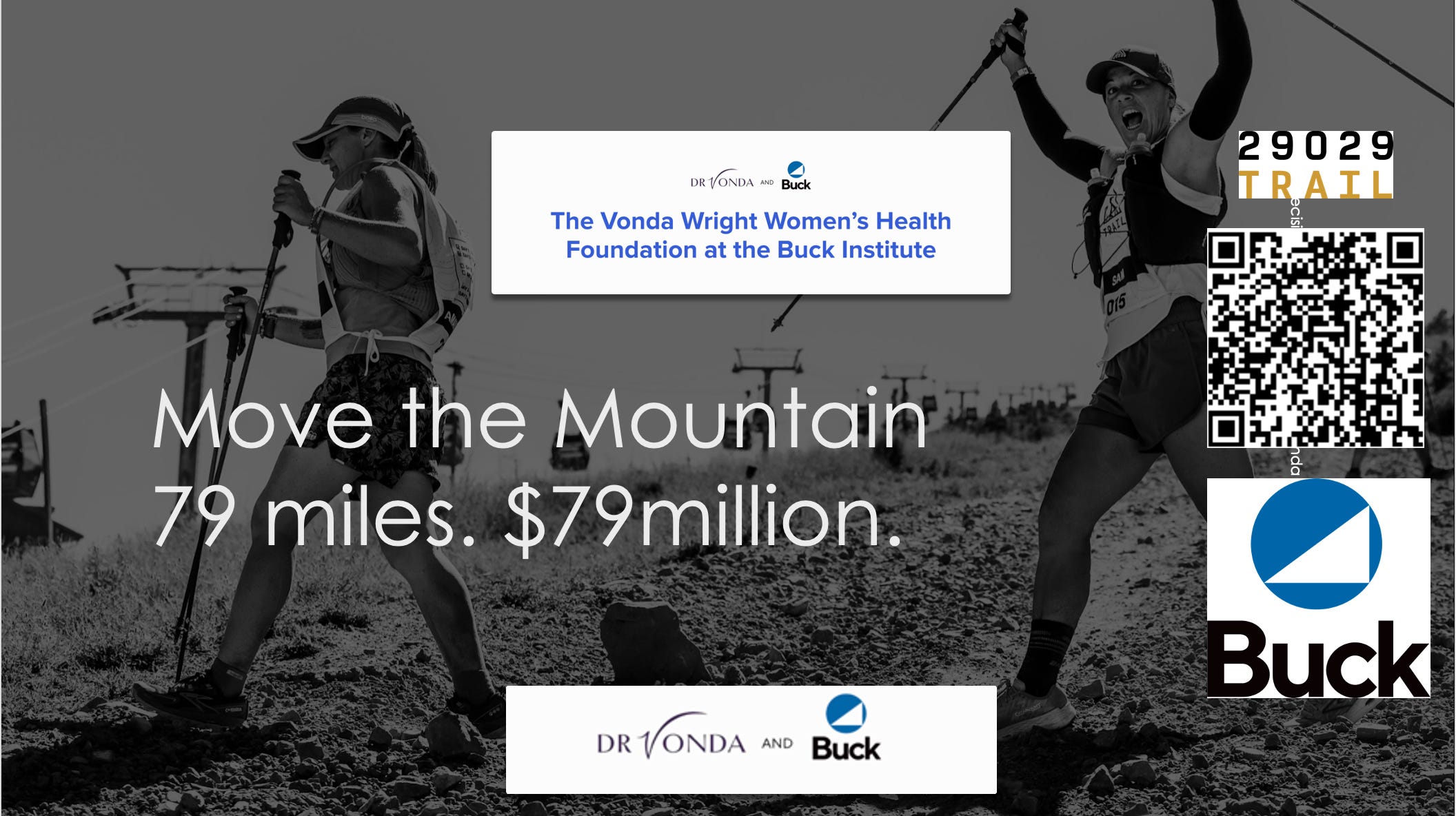
The MOVE the Mountain challenge:
79miles. $79million.1mission
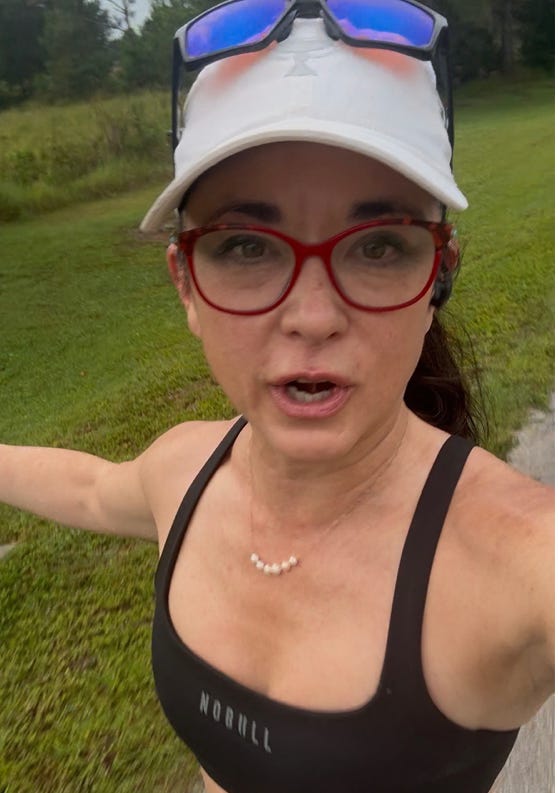
This year, I am putting my body where my mouth is.
On September 16–20, 2026, at the 29029 Trails Race in Park City, Utah—and continuing at the 29029 Everesting Race in 2027—I will undertake a 79-mile mountain endurance race.
It is brutal. It is relentless. It is, quite frankly, unreasonable. And that is exactly the point. Because it mirrors the experience women have had navigating their own health—pushing, adapting, enduring, often without the support, the data, or the systems they deserved in the first place.
I am climbing to raise $79 million—one million dollars per mile—to establish The Dr Vonda Wright Women’s Health Foundation at the Buck Institute for Research on Aging. This will create a permanent scientific and philanthropic platform dedicated exclusively to women’s healthspan, mobility, and aging.
Research that looks at the ovary not as an afterthought, but as a central organ of longevity. Research that understands bone not just as structure, but as a living, communicating system. Research that finally connects hormones, musculoskeletal health, metabolism, and aging into one coherent model of female performance across the lifespan.
This is not charity. This is infrastructure.
Will You Climb With Me?
No single person changes a system. Movements do.
I am asking you—the women who are tired of being told to wait, the leaders who understand that health is the foundation of performance, the families who refuse to watch another generation lose their independence too soon—to join me.
Every gift, whether $79 or $79,000, helps move the mountain forward.
• $79 — The Mountain Mover: Join the virtual challenge. If one million women donate $79, we will move the mountain together.
• $790 — The Stride: Move the mission forward with a deeper commitment to women’s health and longevity research.
• $7,900 — The Summit: Stand with the leaders helping lift women’s health into the national conversation.
The mountain is real. The climb is real. The mission is real.
If you are tired of hearing that the data doesn’t exist, help me build the foundation that will finally create it.

References
[1] National Academies of Sciences, Engineering, and Medicine. “To Advance Women’s Health Research, NIH Should Form New Institute and Congress Should Appropriate New Funding, Says Report.” December 5, 2024. https://www.nationalacademies.org/news/to-advance-womens-health-research-nih-should-form-new-institute-and-congress-should-appropriate-new-funding-says-report
[2] World Economic Forum. “Just 7% of research funding goes towards health issues that affect only women.” https://www.facebook.com/worldeconomicforum/posts/just-7-of-research-funding-goes-towards-health-issues-that-affect-only-women-the/1213134420854794/
[3] Katz Institute for Women’s Health. “The gender gap in health research funding is hurting all of us.” Northwell Health. https://www.northwell.edu/katz-institute-for-womens-health/articles/gender-gap-in-health-research
[4] World Economic Forum. “The state of women’s health – in numbers.” May 1, 2026. https://www.weforum.org/stories/2026/05/womens-health-in-numbers/
Can we make a one time pledge?
Done! Thank you for your care and actions to support us Dr V. Go get 'em! Anita xx